| Rating: | 5 (1 votes) |
| Played: | 79 times |
| Classification: | Casual Games |
Most hide-and-seek games create tension by giving players powerful hunters, dark environments, or scary sound effects.
Meccha Chameleon does none of that.
Its colorful maps, cheerful visuals, and simple mechanics make it look like a relaxing party game. Yet after only a few rounds, I noticed something strange.
I was constantly nervous.
Every second felt like I was about to be discovered, even though nothing on the screen looked threatening.
So what makes such a hide and seek game feel surprisingly intense?
When I started playing, I treated Meccha Chameleon like every other hide-and-seek game.
It never worked. No matter how clever my hiding place seemed, I was usually spotted within seconds. At first, I blamed bad luck. Then I realized the game wasn't asking me to hide. It was asking me to disappear.
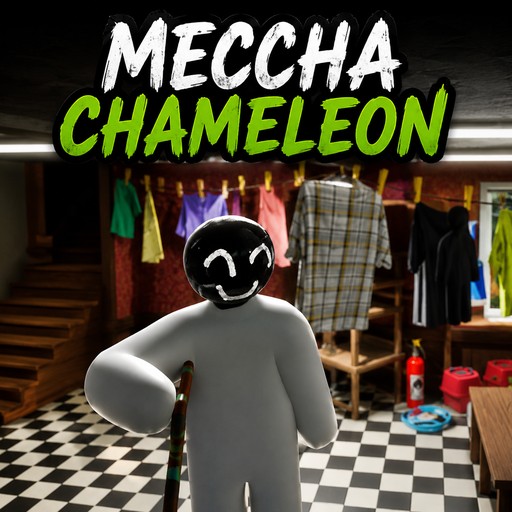
The moment I discovered the paint mechanic, the entire camouflage game felt different.
Instead of transforming into random objects as in traditional prop hunt games, I painted my character to match the surroundings.
Suddenly, I wasn't relying on distance anymore. I was relying on perception. Seekers weren't just searching for players. They were searching for tiny visual mistakes. And somehow, that was much scarier.
After a while, matching colors became easy. Surviving did not. Sometimes my camouflage was nearly perfect, yet I was still caught almost immediately.
Why? Because my position didn't make sense. A perfectly painted character standing in the middle of a pathway still attracts attention. A strange pose creates a silhouette the environment doesn't naturally have. The more I played, the more I realized that every object around me was quietly asking one question:
"Do you belong here?"
If the answer was no, the Seeker would notice.
Most stealth games teach you to watch your enemies. Meccha Chameleon teaches you to watch yourself.
Instead of reacting to danger, you're constantly predicting how another player will think. That mental loop never stops. Even when you're perfectly hidden, you're still wondering if you've overlooked one tiny detail. And that uncertainty creates tension far more effectively than loud music or jump scares ever could.
At first, I thought Meccha Chameleon was a game about finding good hiding spots. Now I think hiding spots are almost irrelevant. The real challenge is convincing another human that you aren't a player at all. You're not hiding behind the environment. You're becoming part of it. That's why every match feels fresh. No two rounds play out the same way. Some Seekers check every corner. Others notice tiny color differences almost instantly. Escaping one player never guarantees you'll fool the next.
Meccha Chameleon, an online browser game filled with bright colors and playful visuals, creates an unexpected kind of suspense. Not through monsters or darkness, but through one simple question that follows you every round: "If you looked at this scene, would you notice yourself?"
Casual Games